
Teddy Bear school
Written by: Meg Buyn and Brittany Braszell
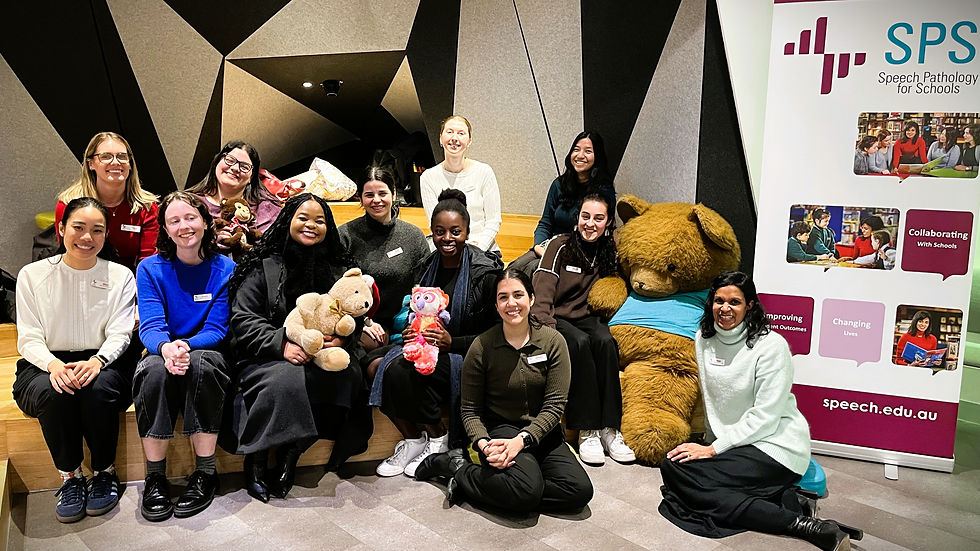
Speech Pathology for Schools’ (SPS) “Teddy Bear School with Speech Pathologists” at REALM Library brought families together for a morning of shared book experiences, play, and early language learning. The SPS team designed the event with three clear learning intentions: to foster an early love of books, to strengthen community and team connection through volunteering, and to support parents in building their children’s language skills through simple, evidence-based strategies. This aligns well with our SPS vision of changing lives for the better by improving literacy and language outcomes.
Throughout the sessions, SPS Speech Pathologists modelled language development strategies with books for parents and their children, using language stimulation strategies such as expanding children’s sentences, asking open ended questions, and using expressive tone, facial expression, and actions to bring the story to life. These interactive techniques are strongly supported in early language research and help children build vocabulary, engagement, and comprehension (Mol et al., 2008).
We used a simple three step structure: the SPS Speech Pathologist modelled the strategy to the parent, the parent practiced the strategy with their child with coaching support from the SPS Speech Pathologist, and then the child had a turn discussing the story with their teddy bear. Parents were provided with a handout of the strategies to use at home. This gradual‑release approach used in the sessions mirrors evidence-based parent coaching models, whereby adults learn best by watching, practicing with support, and then applying strategies independently (Roberts & Kaiser, 2011). Research shows that when parents receive real‑time coaching during shared book interactions, they begin using more language building behaviours such as expanding on their child’s ideas and asking open‑ended questions. Noble et al. (2020) found that these interactive techniques significantly increase the quality of caregiver language input.
The event was a celebration of connection: between families, between SPS team members, and between children and the stories they love. By combining evidence-based practice with warmth, play, and community spirit, SPS’s “Teddy Bear School with Speech Pathologists” helped families discover how small, joyful moments with books can make a big difference in early language development.
References
Galea, C., Jones, A., Ko, K., Salins, A., Robidoux, S., & McArthur, G. (2025). Home-based shared book reading and developmental outcomes in young children: A systematic review with meta-analyses. Frontiers in Language Sciences.
Mol, S. E., Bus, A. G., de Jong, M. T., & Smeets, D. J. (2008). Added value of dialogic parent–child book readings: A meta-analysis. Early Education and Development, 19(1), 7–26.
Noble, C., Cameron-Faulkner, T., Jessop, A., Coates, A., Sawyer, H., Taylor-Ims, R., & Rowland, C. F. (2020). The impact of interactive shared book reading on children's language skills: A randomized controlled trial. Journal of Speech, Language, and Hearing Research, 63(6), 1878–1897. https://doi.org/10.1044/2020_JSLHR-19-00288
Roberts, M. Y., & Kaiser, A. P. (2011). The effectiveness of parent-implemented language interventions: A meta-analysis. American Journal of Speech-Language Pathology, 20(3), 180–199.


Comments